Rule 3
Powers and Rulers
Here I Stand is best played with either three or six players. The rules in this booklet are for a game with six players. The small number of rule changes needed to support play with 3 to 5 players are listed in the section “Games with 3 to 5 Players” in the Scenario Book. Play with 2 players is also possible using the Two-Player Variant presented at the end of the Scenario Book. Unless you are using the Two-Player Variant, all six major powers are assigned to a player and take an active part in the conflict. This section defines players, powers, and rulers and gives high-level information about each of these game concepts.
3.1Player
In the six-player game, each player controls a single major power. In games with three to five players, some players control two major powers so that all major powers are in play.
3.2Power
A power is a nation or city-state present in the game. The Protestant reformers and the German princes who defended their religious changes represent an additional power. There are 10 powers: 6 major and 4 minor. If the text of a rule or card says “power” without specifying “major” or “minor”, the rule pertains to a major power.
Major Power
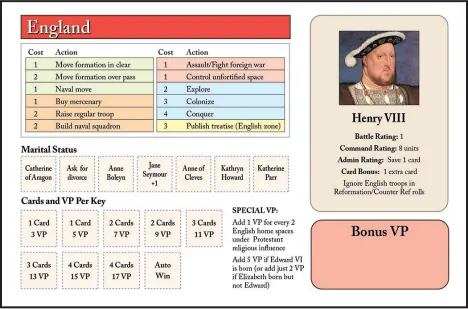
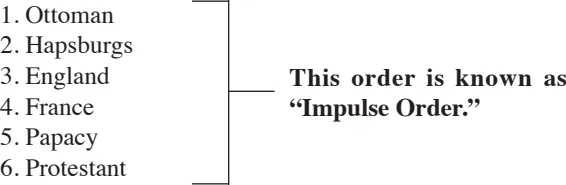
The major powers are England, France, the Hapsburgs, the Ottoman Empire, Papacy, and the Protestants. Each major power has a “power card” (Section 4) that tracks its status with respect to allowable actions, card draws, victory points, and current ruler. Many game functions are conducted one power at a time in the following order:
Minor Power
The minor powers are Genoa, Hungary/Bohemia, Scotland, and Venice. The allegiance of these states can change during play.
3.3Ruler
The ruler of each major power plays an important role during the game, whether monarch, sultan, or pontiff. The rulers of two major powers remain constant throughout the game:
- Hapsburgs always ruled by Charles V
- Ottoman Empire always ruled by Suleiman I
The rulers of the other four major powers change during play as the result of Mandatory Event cards (Section 6.1). The initial ruler for each of these powers is printed on the right side of their power card. Subsequent rulers enter play through Mandatory Event cards. These cards are placed over the ruler printed on the power card so that the new ruler’s attributes are visible to all players.
Attributes
All rulers possess two attributes: administrative rating and card bonus, as described below. English and Papal rulers also affect the resolution of religious conflicts (Section 18). Explanatory text is included on the power card or Mandatory Event card for each English/Papal ruler to show how that ruler alters the resolution of religious conflicts.
Administrative Rating: The administrative (or “admin”) rating of a ruler evaluates that ruler’s ability to conserve national resources so they can be applied in times of need. An administrative rating is always given in terms of the number of cards that ruler can save from one turn to the next.
Card Bonus: The card bonus of a ruler evaluates whether or not a ruler was exceptionally resourceful in mobilizing support for his endeavors. A card bonus is given in terms of the number of extra cards a power is dealt when led by this ruler.
Additional Ruler Functions
The Protestant rulers Luther and Calvin may also affect the game as reformers and as debaters (Section 18). Some rulers may affect the game as army leaders: Suleiman I (Ottoman); Charles V (Hapsburgs); Francis I, Henry II (France); and Henry VIII (England). See Section 5.1. These additional functions are entirely separate from their role as ruler of a major power. While serving in these additional capacities, these rulers function like any other reformer, debater, or army leader and are governed by the appropriate section of the rules for that type of unit.