Rule 6
Cards
The game play in Here I Stand is driven by a single deck of 110 cards. This section explains each of the different types of cards, and how to manage adding and removing cards from the deck.
6.1Card Types
There are five types of cards in the game, as described below. With the exception of Mandatory Event cards, every card may be played as either an event, or as command points (CPs). CPs may be used to take actions (Section 11), or to declare war (Section 9.6). (When playing a Mandatory Event, the event takes effect first, then the active power receives 2 CPs to spend on actions.) If a player uses a card as an event, he or she follows the instructions printed on the card. Some cards have two alternate sets of instructions separated by the word “OR” in capital letters. These cards give the player an option of playing them two different ways. When playing a card with two sets of instructions, only the conditions and effects in the portion of the card chosen by the player apply.
Home Cards
Each power has a specific Home card (the Papacy has two) which starts every turn in their hand. Once used, Home Cards are placed on the appropriate power card (not in the discard pile) to show that they are not available until cards are dealt at the start of the next turn. A player may not pass during his impulse in the Action Phase if a Home Card is still in his hand. Home Cards can never be drawn from a power’s hand when a random draw or discard is required (either by Event card play, diplomatic agreement, or piracy), even if it is the last card in your hand.
Mandatory Event Cards
Cards with the name of the card in red and the word “Mandatory” printed on them are Mandatory Event cards. Mandatory Event must be played during the Action Phase of the turn in which they are drawn. When played, the event is always resolved first, then the playing power receives 2 command points to spend on actions. Mandatory events may never be held from one turn to the next. A player may not pass during his impulse in the Action Phase if a
Mandatory Event card is still in his hand. All Mandatory Events are removed from play after they occur, except Council of Trent and Master of Italy. These two Mandatory Events remain in the deck from turn to turn and may each occur numerous times. Mandatory Events can be drawn from a power’s hand when a random draw or discard is required; in this case the event is not triggered. Mandatory Events cannot be chosen when a player has his choice of card to be discarded (e.g. with the French Chateau table or the events Mercenaries Demand Pay, Sack of Rome, Spanish Inquisition, or Thomas More). If the owning player has his choice of discard and his options for discard consist only of Home Card(s) and Mandatory Events,skip the discard; all those cards remain in that player’s hand.
Response Cards
Cards with the name of the card in blue and the word “Response” printed on them are Response cards. Response cards are playable as an event in the Action Phase during any player’s impulse (including your own). Play of a Response card interrupts a player’s impulse, a battle, or an Event card play. Players should allow a reasonable amount of time for play of a Response card by another player after each action, event, naval combat, or assault. Response cards can also be played for CPs during a player’s impulse if a player does not wish to use the card’s special ability to interrupt another player.
Combat Cards
Cards with the name of the card in black and the word “Combat” printed on them are Combat cards. Combat cards are playable as an event only during a field battle, assault, or naval combat in which the card owner’s units are participating. The Combat card is played just before that battle is resolved. Combat cards can also be played for CPs during a player’s impulse if a player does not wish to use the card’s special ability to be played during combat.
Event Cards
All other cards in the deck are Event cards. The name of these cards appears in black, like Combat cards. These cards are played as events during the owning player’s impulse in the Action Phase. They may also be played for CPs during a player’s impulse if a player does not wish to use the card’s event. Three events (Augsburg Confession,
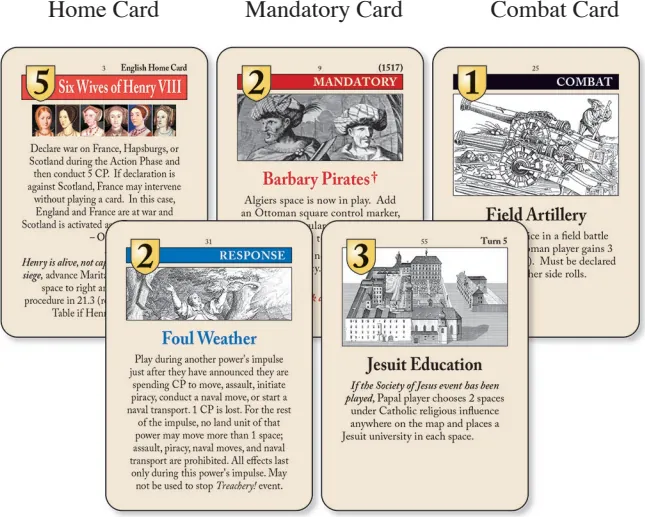
Response Card Event Card
Printing Press, and Wartburg) have game effects that last until the end of the current game turn. A marker is provided in the counter mix for each of these events. Place the appropriate marker on the Turn Track when one of these three cards is played as an event, to remind players that this event is in effect. Three Event cards have special uses elsewhere as events in another phase. These special uses are as follows:
| Card Name | Other Phase Used | Action Phase too? |
|---|---|---|
| Diplomatic Marriage | Diplomacy | Yes |
| Spring Preparations | Spring Deployment | No |
| Venetian Informant | Spring Deployment | No |
Events with an entry of “Yes” in the “Action Phase too?” column may be played as events either in the Action Phase or this other phase. Spring Preparations and Venetian Informant are only playable as an event in the Spring Deployment phase (though they may be used for CP in the Diplomacy or Action Phases).
6.2The Deck
The cards available to each power each turn consist of their Home card(s) and a variable number of cards dealt to that power from a single deck of shared cards. The deck is reshuffled each turn, after any new cards for that turn have been added, and before cards are dealt to each power.
Adding Cards
The upper-right hand corner of 42 cards contains a turn number or the word “Variable.” None of these cards are used on Turn 1.
Instead, at the start of the Card Draw Phase of Turn 3 and later turns, players review each of these cards to see if they should be added to the deck before new hands are dealt. These cards fall into three types:
- 36 of these cards show a turn number, with no further condition. These cards are always added to the deck in the indicated turn.
- 2 of these cards (#19 ‘Edward VI’ and #21 ‘Mary I’) show a turn number with a condition for play. These cards are added to the deck in the indicated turn only if the condition listed is true. If it is false, the card is set aside until the following turn. The card is added to the deck during the Card Draw Phase of the next turn in which the condition is satisfied. These cards may never be added to the deck before the indicated turn, even if the condition is satisfied.
- 4 of these cards read “Variable.” These cards are each added to the deck during the Card Draw Phase of the first turn in which the condition is satisfied.
Cards without a turn number or the word “Variable” start in the deck at the beginning of the game (Exception: In a scenario with the 1532 setup, cards marked with “(1517)” are not included.).
Dealing Cards
Each power is dealt the number of cards indicated in the lower left section of their power card plus one extra card if they receive a card bonus from their ruler. These newly dealt cards are combined with the power’s Home card(s) and any unused cards from the previous turn to form the power’s “hand” for the upcoming turn. The base number of cards dealt falls into two cases:
- 1. All powers except Protestant: Number of cards is determined by the number of square control markers on the board. The last uncovered square in the “Cards and VP Per Key” section shows the number of cards dealt to that power. Squares on a power card can also be covered by Unrest markers (Section 12.4), further reducing the power’s card deal. If all spaces are covered, that power still receives 1 base card.
- 2. Protestant: Number of cards is based on the number of electorates under Protestant political control (5 cards if 4 or more electorates are under Protestant political control; 4 cards if 3 or fewer are controlled).
Powers then receive an extra card (above the base cards) if their current ruler has a Card Bonus. They also receive one less card for each “–1 Card” marker on their power card.
Card Deal Examples
- 1: Luther is the Protestant ruler; the Protestant power has political control of 3 electorates. Receive: 4 cards
- 2: Francis I is the French ruler; the French power has control of 8 keys. Receive: 4 (keys) + 1 (bonus) = 5 cards.
- 3: Suleiman rules the Ottomans. The Ottomans control 7 keys, 2 of which are in unrest. Receive: 4 cards.
Discard Pile & Cards Out of Play
After a card is played, it is either removed from the game or placed in a single discard pile shared by all players:
Out of Play: Cards are removed from the game if they are played as an event and the text “Remove from deck if played as event” or “Remove from deck after play” appears on the card. Cards that may be removed from the deck are marked with a red dagger after the title.
Discard Pile: Cards are always placed in the discard pile if they lack the text “Remove from deck…” Event cards with this text are also placed in the discard pile if they are played for CP, rather than as an event. Two of the cards in the game (Here I Stand and Papal Inquisition) can be exchanged for a card selected from those currently in the discard pile. There are a few restrictions on these retrievals from the discard pile:
- Mandatory Events may never be retrieved from the discard pile, and
- A power may never retrieve a card from the discard pile that this same power played as an Event, Response or Combat card earlier in the turn. (Likewise, the Protestant may not use the card Frederick the Wise to retrieve Wartburg from the discard pile if he already played it a Response this turn.)
The contents of the discard pile (and any card retrieved from it) are public knowledge at all times.
All cards in the discard pile are reincorporated back into the deck during the Card Draw Phase at the start of each turn. These cards are combined with (a) the cards that were not dealt during the previous turn, and (b) the new cards entering play to form the deck for the upcoming turn.