Rule 19
Winter
The seventh phase of each turn is the Winter Phase, which starts immediately after the last impulse of the Action Rounds. During this phase, all players complete the following actions in this order:
- Remove loaned naval squadron markers
- Remove the Renegade Leader if in play
- Return naval units to the nearest port
- Return leaders and units to fortified spaces (suffering attrition if there is no clear path to such a space)
- Remove major power alliance markers
- Add 1 regular to each friendly-controlled capital
- Remove all piracy markers
- Flip all debaters to their uncommitted (white) side, and
- Resolve specific Mandatory Events if they have not occurred by their “due date”.
All actions in the Winter Phase are undertaken by all players simultaneously.
19.1Loaned Squadron Markers
Remove all Loaned markers from naval squadrons. These fleets will return to a port controlled by their owning power in a following step, not to a port controlled by the power to which they have been on loan.
19.2Renegade Leader
Remove the Renegade Leader if brought into play this turn with the event Charles Bourbon. Land and naval units stacked with this extra army leader are not affected.
19.3Returning Home
In the first part of the Winter Phase, naval units are returned to ports. Immediately after naval units have been moved to ports, all land units are moved to fortified spaces.
Naval Units Returning Home
Naval units must be placed in the nearest port controlled by their major power. Squadrons of a controlled minor power have the option to go to the nearest home port of that minor power instead as long as it is also under control of their major power ally. If more than one port is the same distance away, the owning player selects any of these equidistant ports (splitting a stack between several ports if desired). Naval units returning home at this time cannot be intercepted, do not fight naval combat if moving through enemy units, never suffer any attrition, and may return to a port that was under siege at the start of the phase. Naval leaders in a sea zone must return to a port with one of the units that started this phase in the same sea zone. If there is no valid port for a naval squadron to return to, it is eliminated.
Land Units Returning Home
Land units in either unfortified spaces or fortified spaces not controlled by their major power must return to a fortified space that is controlled by their power (with a limit of 4 per space except capitals). Land units already in fortified spaces controlled by their power have the option of returning to their home capital. Land units already in their home capital are the only ones that are prohibited from moving during this phase (all other land units at least have the option to be moved at this time).
Land units move according to the procedure listed below. All land units moving between the same two spaces are moved as a stack. Check for an open path of any length of adjacent land spaces or sea zones from the stack’s current location to its destination. To avoid losing units to attrition, all spaces on the path (except the space where the path begins) must be:
- Friendly-controlled
- Free of unrest.
Note that unlike the determination of LOC (Section 12.1), enemy units are ignored at this time. In addition, paths may be traced over any number of sea zones without a friendly naval unit being present in the sea zone. Because alliances are in effect until the end of the next step of the Winter Phase, land units may trace a path through spaces controlled by allied powers.
If no such path exists, the stack takes attrition, losing half of its units (round up). The owning power chooses which units are lost to attrition.
Land Unit Return Home Procedure
Each power performs the following steps to check the status of all of its land units. This procedure may be performed simultaneously for all powers.
- 1. . Check Stacking Violations: Review all land units that are stacked in fortified spaces controlled by their power (other than the major power in question’s home capital). For each such fortified space that contains more than 4 units, the power must return the excess units to their capital (minor power units could also optionally return to a minor power home key). Other land units in these spaces also have the option of returning to their home capital (or minor key for minor power units) if desired, even if not overstacked. The stack takes attrition (see above) if its path must cross or end on a space in unrest or not under friendly control.
- 2. Return Units: Now review all land units in unfortified spaces and in fortified spaces not controlled by their major power. These units must either:
- Return to their home capital (or minor key for minor power units), or
- Return to the nearest fortified space controlled by their power (but not if that would put more than 4 land units in that space). The nearest space is always computed using a direct path to the destination without regard to which power controls any of the intervening spaces.
The player may split a stack at this time, choosing to move some unitsto the nearest fortified space and returning the rest to the home capital (or minor power key). If more than 1 fortified space is “nearest” (i.e. they are equidistant from the stack’s current location), the player may move units to each of these spaces, as long as the limit of 4 land units is observed. Any stack moving during this phase takes attrition (see above) if its path must cross or ends on a space in unrest or not under friendly control.
3. Return Army Leaders: If a space containing an army leader is vacated during this procedure, that army leader must either accompany one of the land units leaving the space throughout the entire
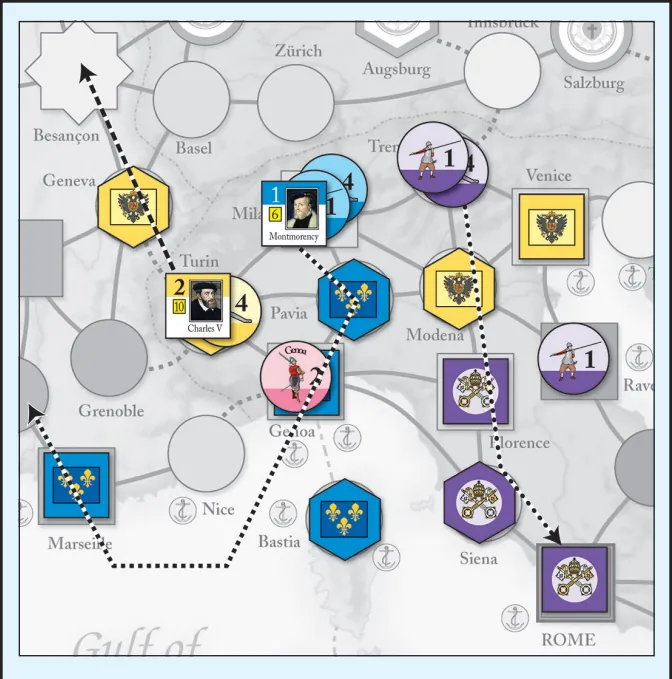
Winter Returning Home Example
It has been a very active campaign in Italy this turn, with the Papacy, France, and Hapsburgs all at war with each other and fighting over control of Milan. The situation at the end of the turn is shown. Genoa is a French ally; Venice is a Hapsburg ally.
Hapsburgs: Charles and the 4 Hapsburg regulars in Turin occupy an unfortified space and must move to the nearest fortified space (or to a capital). They have a path available over the Alps to Besancon. Unfortunately there is no path of Hapsburg controlled spaces all the way to one of their capitals. They choose to return Besancon at full strength, rather than return to a capital; a return to a capital would force them to undergo attrition and lose 2 regulars.
France: Montmorency and the 5 French regulars in Milan occupy a (very important) fortified space. Montmorency and 4 regulars may spend the winter in Milan. The fifth regular must return to the capital. The French have a path of controlled spaces all the way back to Paris (tracing over the Gulf of Lyon from Genoa to Marseille); this fifth unit is needed back in Paris and returns over the path shown above. The 2 Genoese regulars in Genoa remain there, though either or both of them could have returned to Paris if desired.
Papacy: The 5 Papal regulars in Trent occupy an unfortified space and must move to Rome or the nearest fortified space. In either case, they will move through an enemy space and lose three units to attrition. Ravenna and Florence are both 2 spaces away; the Papacy may choose to return the 2 surviving units to any combination of those 3 spaces. The Papacy chooses to return 2 of those regulars to Rome and to leave its regular in Ravenna (instead of having it also return to Rome).
winter move or return to the power’s capital.
There are four exceptions to the rules in this procedure:
-
- PROTESTANT UNITS: Since the Protestant player has no capital, Protestant land units are always moved to the nearest fortified space under Protestant control that can accommodate the units while remaining within the limit of 4 or fewer units per fortified space. Land units that start the phase in a stack may of necessity be split up and moved to separate spaces (Once the nearest fortified space fills to 4, compute the new nearest space.)
-
- ENEMY-CONTROLLED CAPITAL: If a power’s capital is currently controlled by an enemy power, none of its land units may be returned to the capital. All units that would normally have been required to return to the capital are eliminated instead.
-
- HAPSBURG UNITS: Since the Hapsburg player has two home capitals, his units may return to either capital in Steps 2 and 3 of the Land Unit Return Home Procedure. The Hapsburg player may not move units into or through an electorate if the Schmalkaldic League Mandatory Event has not been played.
-
- SCOTTISH UNITS: Scottish land units must winter in either Edinburgh or Stirling. Scottish land units may return to either of these two spaces as if they were each a minor power key. Any Scottish land units that cannot return to one of these two spaces (because they are under enemy control) are eliminated.
19.4Major Power Alliance Markers
Remove all Allied markers between Major Powers from the Diplomatic Status Display. All alliances declared for this turn during the Diplomacy Phase are over; all alliances with minor powers created through play of Event cards remain in effect.
19.5Replacements
Each power now adds 1 regular to its capital if it is under friendly control and not in unrest. The Hapsburgs check both capitals and can receive a regular at each capital at this time if that space is both controlled and not in unrest. The Protestant never receives units at this time.
19.6Piracy Markers
Remove all piracy markers from the map at this time.
19.7Debaters
Flip all debaters to their white, uncommitted side.
19.8Mandatory Events
The following events must occur by a specified “due date”. If it is the Winter Phase of the indicated turn and that event has not yet been triggered, resolve the event at this time. The card is extracted from the deck and removed from play as if it had been played by one of the powers. The 2 CP normally granted to the power playing such a card during the Action Phase are ignored.
| Event | Required by Winter Phase of: |
|---|---|
| Clement VII | Turn 2 |
| Barbary Pirates | Turn 3 |
| Schmalkaldic League | Turn 4 |
| Paul III | Turn 4 |
| Society of Jesus | Turn 6 |