Rule 18
The Reformation
The religious struggle started by Luther’s 95 Theses in 1517 takes place during the game at the same time as the military campaigning covered in the earlier rule sections. This section presents all the rules governing the religious conflict. Although the Papacy and the Protestant power are the key figures in the religious arena, the English and Hapsburg powers both have a vested interest in the outcome. The religious actions that trigger a change in religious status are presented first below. These are followed by detailed instructions on resolving the Reformation attempts, Counter Reformation attempts, and Theological Debates that result from these actions.
18.1Religious Actions
The following eight sections describe the actions that affect the religious status of Europe. The first two items (Luther’s 95 Theses and the Diet of Worms) occur automatically at the start of Turn 1 to represent Luther’s initial attack on the institutions of Catholicism. The remaining six religious actions are initiated through the expenditure of CP during the action cycle.
Luther’s 95 Theses
The first phase of Turn 1 is always the play of the Mandatory Event card Luther’s 95 Theses by the Protestant player. This card always starts the game in the possession of the Protestant player (and note that cards are not dealt until after the Luther’s 95 Theses Phase). This event has the following effects:
- Luther is added to the Wittenberg space (Section 8.2)
- Wittenberg comes under Protestant religious influence (and the 2 Protestant regulars on Wittenberg in the Electorate display are added to the space, see 21.6)
- The Protestant power makes 5 Reformation attempts targeting the German language zone. These attempts are resolved as described in Section 18.3. The Protestant rolls one extra die in each attempt.
This Mandatory Event card is then removed from the deck. Luther’s 95 Theses is the only Mandatory Event that does not grant the player 2 CPs after the event is resolved.
Diet of Worms
The fourth phase of Turn 1 is always the Diet of Worms phase. In 1521, the newly-appointed Holy Roman Emperor Charles V reviewed Luther’s teachings in front of this German legislature. In the game, the Diet is played out using the following procedure.
Diet of Worms Procedure
- 1. Select Commitment Card: The Protestant, Hapsburgs, and Papacy all secretly select one card from their hand to represent their level of commitment to these proceedings. Each of these powers must play a card. The card may not be a Mandatory Event. A power may choose its Home card. Cards with higher CP values represent higher levels of commitment.
- 2. Reveal Cards: All chosen cards are simultaneously revealed.
- 3. Roll Protestant Dice: The Protestant player adds 4 to the CP value of his card. This total represents the number of dice he now rolls. Each roll of a “5” or a “6” is considered to be a hit.
- 4. Roll Papal and Hapsburg Dice: The Papal player rolls a number of dice equal to the CP value of his card. The Hapsburg player does the same. Each roll of a “5” or a “6” is considered to be a hit. These two powers combine their hits into a Catholic total.
- 5. Protestant Victory: If the number of Protestant hits exceeds the number of Catholic hits, the Protestant power flips a number of spaces equal to the number of extra hits he rolled to Protestant influence. All spaces flipped must be in the German language zone. Spaces flipped must be adjacent to another Protestant space; spaces that were just flipped in this step can be used asthe required adjacent Protestant space.
- 6. Catholic Victory: If the number of Catholic hits exceeds the number of Protestant hits, the Papacy flips a number of spaces equal to the number of extra hits he rolled to Catholic influence.All spaces flipped must be in the German language zone. Spaces flipped must be adjacent to another Catholic space; spaces that were just flipped in this step can be used as the required adjacent Catholic space.
- 7. Draw: If the number of Protestant and Catholic hits is equal, the Diet is inconclusive. No action is taken.
Publishing a Treatise
The Protestant power may spend 2 CPs on the Publish Treatise action. The Protestant power makes 2 Reformation attempts targeting a single language zone. This target language zone must be specified before attempting the first Reformation attempt (Section 18.3). If Cranmer is on the map, the English power may also undertake the Publish Treatise action, although the cost for the action is 3 CP. Treatises published by the English always target the English language zone.
Biblical Translations
The Protestant power (only) may spend 1 or more CP on the Translate Scripture action. In the game, completion of a translation represents the huge boost the Protestant faiths received for offering biblical texts in worshippers’ native languages. For each CP spent, advance one marker one space on either the New Testament translation track or the Full Bible translation track on the Protestant power card. Several debaters (Luther, Melanchthon, Tyndale, Coverdale, Olivetan) have bonuses that allow the marker to be advanced one additional space without spending a CP if that debater is committed during this impulse (see 18.2 below). Only one bonus space can ever be awarded in a single impulse. The appropriate portion of the Protestant power card is shown below for ease of reference. There are three markers on each of these two tracks, one for each of these three language zones: German, English and French. The Protestant may not advance the Full Bible marker in a language zone until the New Testament is complete for that language.When a marker reaches the final space on the track, the translation is complete. The Protestant must advance a marker 6 spaces to complete translation of the New Testament in each language, and 10 spaces to translate the Full Bible in a language. Immediately upon completion of a New Testament translation, the Protestant power may make 6 Reformation attempts, targeting the language zone that matches the language of translation. Immediately upon completion of a Full Bible translation, the Protestant power may make 6 Reformation attempts, targeting the language zone that matches the language of translation and all dice rolled by the Protestant receive a +1 die roll modifier (i.e. possible results range from 2-7). In addition, the Protestant player earns 1 bonus VP when each Full Bible translation is completed. Once these markers reach a final box, there is no reason to continue to pay CP to advance them; each translation may only occur once in a given game.
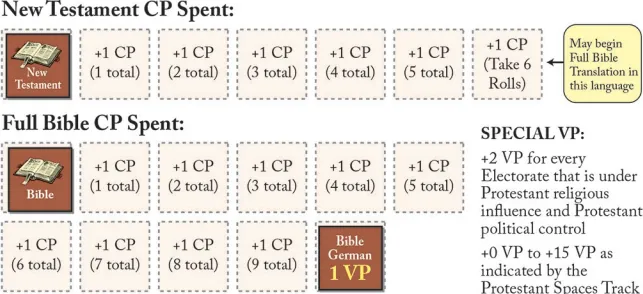
Biblical translation section of the Protestant power card
Calling Theological Debates
Both the Protestant and Papal powers may spend 3 CPs to Call a Theological Debate in one of these three language zones: German, English and French. If all Protestant debaters in a language zone are committed, the Protestant player may not initiate debates in that language zone. Similarly, if all Papal debaters are committed, the Papal player may not initiate debates in any language zone. If none of the Protestant debaters for a language zone have entered the game (or all of them have been burnt at the stake, excommunicated, or removed from play), neither player may call a debate in that zone. Complete rules on how to resolve a theological debate are found in Section 18.5. This action can be triggered by a card play by the English power if Mary I is ruler of England (Section 21.3). Certain Event cards also result in the calling of a debate.
Building Saint Peter’s
The Papal power (only) may spend 1 or more CP on the Build Saint Peter’s action. This action represents spending money on the Papacy’s main building project of the time: the refurbishment of St. Peter’s Basilica. For each CP spent, advance the “St. Peter’s CP” marker one space to the right on the Papacy’s power card. If the marker reaches the rightmost space, labeled “+1 CP (Add 1 VP, Set to 0)”, reset this marker to the “At Start: 0 CP” space and move the “St. Peter’s VP” marker on the line below one space to the right. The Papacy may never earn more than 5 VP from St. Peter’s construction in a single game.
Burning Books
The Papal power may spend 2 CPs on the Burn Books action. The Papal power makes 2 Counter Reformation attempts targeting any single language zone. This action can also be triggered by a card play by the English power if Mary I is ruler of England (Section 21.3).
Founding a Jesuit University
After the Society of Jesus Mandatory Event has been played, the Papal power may spend 3 CPs on the Found Jesuit University action. The Papal power adds a Jesuit university marker to a Catholic space (that does not yet have such a university). The cost of adding a Jesuit university is reduced to 2 CPs if the debater Loyola is committed during this action (see 18.2 below).
18.2Religious Modifiers
The chance of success of a Reformation or Counter Reformation attempt on a space is based on the board position in and adjacent to the target space. The religious affiliation of adjacent spaces is the most important variable, but the presence of reformers, Jesuit universities, and some land units also affects those religious conflicts. Each debater present in the game has a unique special bonus; many of these bonuses also serve as modifiers to religious activities.
Reformers
The four Protestant reformers are placed on the map as described in Section 8.2. Each of these reformers provides a strong positive modifier for the Protestant in Reformation and Counter Reformation attempts nearby (2 extra dice in the same space as the reformer, 1 extra die in all adjacent spaces).
Jesuit University
Two Jesuit Universities are placed on the map when the Society of Jesus Mandatory Event is played. After that event has been played, the Papacy may then start adding additional Jesuit universities. Each of these universities provides a strong positive modifier for the Papacy in Reformation and Counter Reformation attempts nearby (2 extra dice in the same space as the university, 1 extra die in all adjacent spaces).
Land Units
Land units that have Protestant and Catholic leanings have the same effect as reformers/Jesuit universities on nearby Reformation and Counter Reformation attempts. The sections below describe which armies fall into each religious camp (note that a few units are unaligned and have no effect on the religious struggle). Each stack of land units only modifies a religious attempt once; there is no cumulative effect for having additional land units (or army leaders) in a space.
Protestant land units are:
- Protestant regulars and mercenaries.
- English regulars and mercenaries if either Edward VI or Elizabeth I rules England.
Catholic land units are:
- Papal regulars and mercenaries.
- Hapsburg regulars and mercenaries.
- French regulars and mercenaries.
- English regulars and mercenaries if Mary I rules England.
- Regulars of all four minor powers (Genoa, Hungary-Bohemia, Scotland and Venice). Exception: While Scotland is allied with England, Scottish units are treated the same as English ones.
- Independent regulars including the Knights of St. John.
Unaligned land units are:
- Ottoman regulars and cavalry.
- English regulars and mercenaries if Henry VIII rules England.
Unaligned land units are ignored in religious conflicts.
Debater Bonuses
The front (uncommitted) side of each debater contains text describing the unique special bonus that this debater provides. If uncommitted, a debater may use his bonus to increase the chance of success of Reformation attempts, Counter Reformation attempts, Theological Debates, and the Council of Trent. These bonuses also can be used to make actions more cost effective. When a debater bonus is used, that debater counter is flipped to the gray, committed side. Debaters also become committed when events requiring their presence are played and when they are involved in theological debates. Debaters are flipped back to the uncommitted side during the Winter Phase. The following restrictions apply to these debater bonuses:
Restrictions:
- Debaters that were committed earlier in the turn may never use their bonus.
- Debater bonuses last for that one Event card play or action only. A bonus may not be applied repeatedly to multiple actions in the same impulse. (Example: With Loyola’s bonus, only one Found Jesuit University action can be discounted to 2 CP. Building two universities in a single impulse would thus cost 5 CP: one at 2 CP and one at the full price of 3 CP).
- Each power that can undertake religious actions (England, Protestant, and Papacy) may only use one debater’s bonus in a given impulse that applies during Reformation or Counter Reformation attempts or biblical translations. Debaters whose bonuses apply during theological debates always apply their bonus if they enter a debate uncommitted (i.e. it is not optional). Flipping a debater to his committed side to fulfill the requirement for playing an Event card does not count as using a debater bonus in an impulse. (Example: The Protestant plays the event Katherina Bora which flips Luther to the committed side. The Protestant may commit another debater to get bonus dice on the Reformation attempts generated by this event.)
- Debater bonuses may be used during other power’s impulses. Thus, a power might play an event on behalf of the Protestant or Papal player, or the English power may publish a treatise in the English language zone. The English, Protestant, and Papal players may use debater bonuses to improve the effectiveness of such an activity. The decision to allocate debater bonuses is always made by the player initiating the religious action; note that since England can only publish treatises, the only debaters they can allocate are Cranmer, Latimer, Wishart, and Knox.
- A debater who provides “Bonus CP” for translation in a language zone may only use their bonus if the Protestant spent one or more CP on translating in that zone this impulse.
- Debaters who provide extra Reformation or Counter Reformation attempts during a publish treatise or burn books action (e.g. Carlstadt, Cajetan, Caraffa, and Calvin) must be committed before any of the attempts for that action are made. (However debaters who provide a bonus die roll for such an action may be committed in the middle of the string of attempts, as long as it is before any dice are rolled for the first attempt in which their bonus die is being applied).
18.3Reformation Attempts
The following actions award a player one or more Reformation attempts (notes in parentheses give the target language zone(s) and the number of attempts):
- Luther’s 95 Theses (German zone, 5 attempts with one extra die in each)
- Publishing a treatise (zone is chosen by power taking action. 2 attempts normally). If Carlstadt’s debater bonus is used, make 3 attempts which all must be in German zone. If Calvin’s debater bonus is used, make 3 attempts which all must be in French zone.
- Finishing a New Testament translation (Zone determined by language of translation; 6 attempts)
- Finishing a Bible translation (Zone determined by language of translation; 6 attempts with +1 die roll modifier added to each Protestant die).
A number of Event cards also award Reformation attempts (target language zone as listed; number in parentheses is the number of attempts):
- German language zone: A Mighty Fortress (6).
- French language zone: Affair of the Placards (3), Calvin’s Institutes (5 with +1 die roll modifier added to each Protestant die)
- English language zone: Book of Common Prayer (4), Dissolution of the Monasteries (3).
- All language zones: Marburg Colloquy (sum of 2 German debaters), Erasmus (4), Katherina Bora (5), and Printing Press (3 with one extra die in each Reformation Attempt for the rest of the turn).
Many of these events are only playable if a specific debater is still uncommitted. Upon play of an Event card with such a requirement, regardless of which power played it, the appropriate debater is automatically flipped to the committed side.
Each Reformation attempt gives the Protestant player (or English player if this is one of the two attempts from an English Publish Treatise action) a chance to flip a single space to Protestant religious influence. Resolve each Reformation attempt according to the following procedure. Each space on the map can only be the target for a Reformation attempt once per impulse. If the Protestant (or English) power fails to convert a space, they must wait until a future impulse before trying again. Spaces may be chosen for an attempt even if outside the target language zone or outside all language zones (though as you will see below the chances of success on such a space are reduced).
Reformation Attempt Procedure
- 1. Pick Target Space: For each attempt, the attempting power picks a target space. This space must be Catholic and either:
- Contain a reformer,
- Be adjacent to a space under Protestant religious influence (even if across a pass), or
- Be a port connected to a sea zone that contains other ports under Protestant religious influence.
The chosen space may be in any language zone, but the attempting power will only win ties and receive +1 die roll modifiers (if applicable) if the space is in the target language zone(s). The event Book of Common Prayer is further restricted to allowing only English home spaces (which includes Calais) as targets.
- 2. Add Up Reformer Dice: The attempting power adds up the base number of dice to roll:
- 1 die for each adjacent space under Protestant religious influence
- 1 die for each adjacent reformer
- 1 die for each adjacent stack of Protestant land units
- 2 dice if reformer in target space
- 2 dice if there is a stack of Protestant land unitsin the target space.
The attempting power always rolls at least 1 base die, even if none of the items above applies to the target space (such as a space that is across a pass from all adjacent Protestant spaces). Adjacent spaces, adjacent reformers, or adjacent stacks of units that are either (a) across a pass or (b) in a space that is in unrest do not provide extra dice. Note: A single unit is considered to be a “stack” for the purpose of this procedure.
- 3. Add Bonus Dice: The attempting power then adds bonus dice to the base dice if any of the following conditions are met:
- 1 die if the Printing Press event has been played this turn
- 1 die if this is an attempt from the Luther’s 95 Theses event
- 1 die if an applicable debater bonus applies to this Reformation attempt.
The total is the number of dice used in Step 4.
- 4. Roll Dice: The attempting power rolls this many dice. He adds a +1 die roll modifier to each roll if this attempt was generated by Calvin’s Institutes or a Full Bible translation and if this attempt is in the target language zone(s). The attempting power remembers the highest single modified roll achieved; unlike other combats, he does not count the number of hits.
- 5. Automatic Success: If the highest modified roll achieved is a 6 or higher and this is a space within the target language zone, this Reformation attempt has succeeded without a Papal challenge. Flip the target space to Protestant religious influence and skip the rest of the steps in this procedure.
Otherwise, the Papacy may attempt to stop this attempt.
- 6. Add Up Papal Dice: The Papal power adds up how many dice to roll:
- 1 die for each adjacent Catholic space
- 1 die for each adjacent Jesuit university
- 1 die for each adjacent stack of Catholic land units
- 2 dice if Jesuit university in space
- 2 dice if stack of Catholic land units in space
The Papacy always rolls at least 1 die, even if none of the items above applies to the target space. Adjacent spaces, adjacent universities, or adjacent stacks of units that are either (a) across a pass or (b) in a space that is in unrest do not provide extra dice.
- 7. Roll Papal Dice: The Papal power rolls this many dice and remembers the highest single roll achieved.
- 8. Determine Result: If the highest single modified Protestant die roll exceeds the highest single Papal die roll, the space is flipped
Reformation Attempt Example
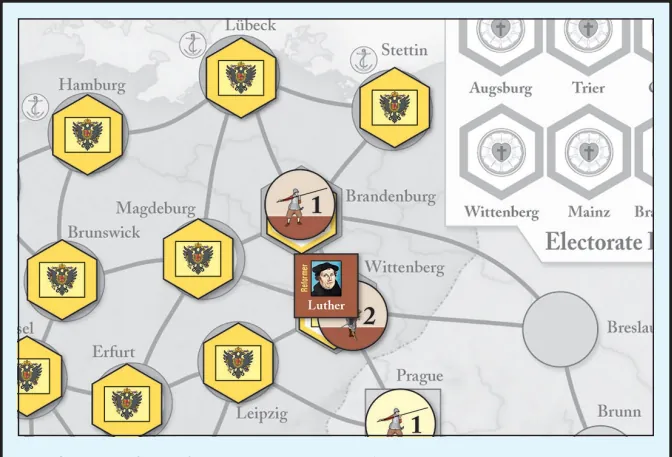
It is the Luther’s 95 Theses Phase at the beginning of Turn 1. The Protestant player has already taken his first Reformation attempt and successfully flipped Brandenburg to Protestant influence. As specified in Section 21.6, this conversion of an electorate allows the Protestant player to take the 1 regular listed for Brandenburg on the Electorate display and place it on the map in this space. The situation is shown below:
The Protestant player is unsure which space to target with the next Reformation attempt. He therefore decides to compute the odds against all spaces eligible for a Reformation attempt (remember that the Luther’s 95 Theses card grants one extra die on each attempt):
Lubeck: 3 Protestant dice (1 die for adjacent space under Protestant religious influence, 1 die for adjacent stack of Protestant land units, 1 die for 95 Theses) vs. 3 Papal dice (all for adjacent Catholic spaces). In German language zone, so Protestant will win a tie.
Stettin: 3 Protestant dice (1 adjacent space, 1 adjacent stack, 95 Theses) vs. 1 Papal die (1 adjacent space). In German language zone, so Protestant will win a tie.
Breslau: 6 Protestant dice (2 adjacent spaces, 2 adjacent stacks, 1 adjacent Reformer, 95 Theses) vs. 1 Papal die (1 adjacent space). Outside German language zone, Papacy wins a tie.
Prague: 4 Protestant dice (1 adjacent space, 1 adjacent stack, 1 adjacent Reformer, 95 Theses) vs. 5 Papal dice (3 adjacent spaces, 1 stack of Catholic land units in space). Outside German language zone, Papacy wins a tie.
Leipzig: 4 Protestant dice (1 adjacent space, 1 adjacent stack, 1 adjacent Reformer, 95 Theses) vs. 4 Papal dice (3 adjacent spaces, 1 adjacent Catholic stack). Protestant wins a tie.
Magdeburg: 6 Protestant dice (2 adjacent spaces, 2 adjacent stacks, 1 adjacent Reformer, 95 Theses) vs. 3 Papal dice (3 adjacent spaces). Protestant wins a tie.
Based on the odds, Breslau and Magdeburg look like the best targets. The Protestant chooses Magdeburg since he win a tie there and doesn’t have to fear that he will lose automatically as soon as the Papacy rolls a 6.
to the Protestant side. If this is an electorate being converted to the Protestant religion for the first time, place a Protestant regular in as specified in Section 21.6. If the highest Protestant roll is lower, the attempt fails. Add an unrest marker to the target space if this was an attempt in the German language zone and the Carlstadt debater bonus was used. The Protestant (or English) power wins ties within the target language zone(s); the Papacy wins ties everywhere else.
NOTE: When switching spaces to Protestant religious influence, note that there are no control makers for minor powers. Minor power home spaces that become Protestant are marked by placing independent (gray) control markers on their white fill side.
18.4Counter Reformation Attempts
The following actions award the Papal player one or more Counter Reformation attempts (number in parentheses is the number of attempts):
- Burning books(2 normally; 3 in a single language zone if Cajetan’s debater bonusis used; 3 in any language zone if Caraffa’s debater bonus is used).
- These events cards: Defender of the Faith (3), Mary Defies Council (3), and Erasmus (4).
Each Counter Reformation attempt gives the Papal player a chance to flip a single space back to Catholic religious influence. Resolve each attempt according to the following procedure. Each space on the map can only be the target for a Counter Reformation attempt once per impulse. If the Papal player fails to convert a space, he must wait until a future impulse before trying again. Spaces may be chosen for an attempt even if outside the target language zone or outside all language zones (though as you will see below the chances of success on such a space are reduced).
Counter Reformation Procedure
- 1. Pick Target Space: For each Counter Reformation attempt, the Papal power picks a target space. This space must currently be Protestant and must either:
- Contain a Jesuit university,
- Be adjacent to a space under Catholic influence (even if across a pass), or
- Be a port connected to a sea zone that contains other ports under Catholic religious influence.
The chosen space may be in any language zone, but the Papacy will only win ties if Paul III or Julius III is the Papal ruler and the space is in the target language zone(s).
- 2. Add Up Catholic Dice: The Catholic player adds up the number of dice to roll:
- 1 die for each adjacent Catholic space
- 1 die for each adjacent Jesuit university
- 1 die for each adjacent stack of Catholic land units
- 2 dice if Jesuit university in target space
- 2 dice if stack of Catholic units in target space
The Papacy always rolls at least 1 die, even if none of the items above applies to the target space. Adjacent spaces, adjacent universities, or adjacent stacks of units that are either (a) across a pass or (b) in a space that is in unrest do not provide extra dice.
NOTE: A single unit is considered to be a “stack” for the purpose of this procedure.
- 3. Determine Bonus Dice: The Papal player then adds 1 or 2 bonus dice to the base dice if an applicable debater bonus applies to this Counter Reformation attempt.
- 4. Roll Papal Dice: The Papal power rolls this many dice. He subtracts 1 from each die roll if the event Augsburg Confession was played this turn. The Papal player remembers the highest single roll achieved; unlike other combats, he does not count the number of hits.
- 5. Automatic Success: If the highest modified roll achieved is a 6, this is a space within the target language zone, and Paul III or Julius III is the current ruler of the Papacy, this Counter Reformation attempt has succeeded without a Protestant challenge. Flip the target space to Catholic religious influence and skip the rest of the steps in this procedure. Otherwise, the Protestant may attempt to stop this attempt.
- 6. Adds Up Protestant Dice: The Protestant power adds up how many dice to roll:
- 1 die for each adjacent space under Protestant religious influence
- 1 die for each adjacent reformer
- 1 die for each adjacent stack of Protestant land units
- 2 dice if reformer in space
- 2 dice if stack of Protestant land units in space
The Protestant always rolls at least 1 die, even if none of the items above applies to the target space. Adjacent spaces, adjacent reformers, or adjacent stacks of units that are either (a) across a pass or (b) in a space that is in unrest do not provide extra dice.
- 7. Roll Protestant Dice: The Protestant power rolls this many dice and remembers the highest single roll achieved.
- 8. Determine Result: If the highest single Papal modified die roll exceeds the highest single Protestant die roll, the space is flipped to the Catholic side. If the highest Papal roll is lower, the attempt fails. The Papacy wins all ties if this is a space within the target language zone and Paul III or Julius III is the Papal ruler; otherwise the Protestant wins all ties.
- 9. Award CP: Award 1 CP toward St. Peter’s construction if Tetzel’s debater bonus was used in this attempt.
18.5Theological Debates
Calling a Theological Debate is less predictable than using Reformation (or Counter Reformation) attempts, but it does offer the following potential benefits:
- Victory Points(VP) can be earned for burning or disgracing enemy debaters, and
- Spaces may be converted to your denomination even if you don’t have many positive religious modifiers nearby.
Theological Debate Procedure
- 1. Specify Language Zone: The attacker specifies the language zone for the debate: German, French or English.
- 2. Choosing the Attacker: The power initiating the debate randomly picks an uncommitted debater to serve as the attacker in this debate. The Protestant must select from the pool of uncommitted debaters for that language zone. The Papacy always selects from its full pool of uncommitted debaters, regardless of the language zone where the debate is being held. This debater is placed on the “Current Debater”
box for this power on the Religious Struggle Card.
- 3. Choosing the Defender: The power initiating the debate has two options when choosing who to target with a theological attack. They may either:
- choose a random enemy debater from the pool of committed enemy debaters (of the proper language zone if the target is the Protestant), OR
- choose a random enemy debater from the pool of uncommitted enemy debaters (again of the proper language zone if the target is the Protestant).
The defender chosen is placed on the “Current Debater” box for this power.
Exception to Steps 2 and 3: If this debate was called with the Leipzig Debate Home card, the Papal player can either select his own attacker or specify that one Protestant debater is not available to defend during any round of this debate. Likewise, the Protestant player may play Here I Stand at this time to substitute Luther for another debater (attacking or defending), as long as this debate is occurring in Germany. Here I Stand may be used to substitute Luther even if the Papacy already specified that Luther was not available with Leipzig Debate and even if Luther is committed.
4. Debate Initiator Rolls Dice: The power initiating the debate rolls a number of dice equal to the value of the debater plus 3. Each roll of a “5” or a “6” is considered to be a hit.
Exceptions:
- The number of dice rolled by a Papal debater initiating a debate is reduced by 1 if the event Augsburg Confession was played this turn.
- The debate value of a Papal debater in the English language zone is doubled in this step if Mary I rules England.
- If the debater Eck or Gardiner was chosen in Step 2, their debater bonuses allows one additional attack die in a debate.
- A Papal debater rolls additional attack dice if they have initiated a debate from either the event Thomas More or Papal Inquisition.
- 5. Debate Defender Rolls Dice: The number of dice rolled by the defending power varies based on whether or not the defender was already committed prior to the debate:
- If committed: Debate value of debater plus 1 die
- If uncommitted: Debate value of debater plus 2 dice.
Each roll of a “5” or a “6” is considered to be a hit.
-
6. Flip Debaters: Flip these two debaters to their committed side. Also flip a debater that Luther replaced to his committed side.
-
7. Compare Dice Rolls: Compare the number of hits for each side. The possible outcomes are:
-
Equal hits on both sides; this is the first round of the debate: The debate enters a second round using new debaters. Both players select a second debater at random from among those debaters still uncommitted in this language zone. If no uncommitted debaters remain, the debater is chosen at random from the pool of committed debaters in this zone. The Protestant player may instead commit Bullinger to use his debater bonus at this point; if so, Bullinger is inserted as the second round debater (before the random determination is made). The Protestant player also may play Here I Stand at this time to substitute Luther for another debater as long as this debate is occurring in Germany. After both second round debaters are selected, return to Step 4.
-
Equal hits on both sides; this is the second round of the debate: The debate is inconclusive. The action is over.
-
One side has more hits: The difference in the hit total is the number of spaces that the winning side may flip to their religious influence. All spaces flipped must be in the language zone in which the debate was held if possible. Once all spaces in the chosen language zone are flipped to the winning denomination, additional hits are then used to flip spaces in any other language zone. Spaces flipped to Protestant influence must be eligible for a Reformation attempt as specified in Step 1 of the Reformation Procedure. Spaces flipped to Catholic influence must be eligible for a Counter Reformation attempt as specified in Step 1 of the Counter Reformation Procedure. The result of the debate may be modified if Aleander or Campeggio was the final Papal debater, as specified by their debater bonus text, assuming they were not committed prior to this round of the debate.
-
8. Burn Protestant Debater: If the Papal player won the debate and the difference in the hit total was greater than the debate value of the Protestant debater, that debater is burnt at the stake! Place him in the Bonus VP box of the Papacy’s power card. The Papacy earns VP equal to his debate value. In the unlikely event that the burnt Protestant debater was Luther, Zwingli, Calvin or Cranmer, remove the matching reformer from the map at this time. Note that a burnt debater never affects the status of the Protestant ruler. Thus if Luther or Calvin is burnt while the current ruler of the Protestant power, retain their ruler attributes anyway. It is assumed that an equivalent replacement is found within the ranks of the Protestant movement.
-
9. Disgrace Papal Debater: If the Protestant player won the debate and the difference in the hit total was greater than the debate value of the Papal debater, that debater is disgraced! Place him in the Bonus VP box of the Protestant’s power card. The Protestant earns VP equal to his debate value.
THEOLOGICAL DEBATE EXAMPLE: It is the Papal impulse on Turn 1. The only committed debater is Carlstadt, whose debater bonus was used in an earlier Protestant impulse to give the Protestant three Reformation attempts for publishing a treatise. The Papal player plays the Leipzig Debate Home card, using that event’s special ability to choose his debater (Eck). Eck will roll 7 dice (3 for his debate value, plus 3 as attacker, plus 1 more for his debater bonus). Since Carlstadt was committed, he will defend with only 2 dice (1 for his debate value, plus 1 as a committed defender). The odds look grim, so the Protestant player uses Here I Stand to substitute Luther for Carlstadt (drawing a new card from the deck as specified on that Home card). Luther (previously uncommitted), defends with 6 dice (4 for his debate value, plus 2 as an uncommitted defender). Both sides roll and each scores 2 hits. The debate is inconclusive; another round of debate is necessary. Both Eck and Luther are now committed. The attacker is now randomly determined from uncommitted Papal debaters; Aleander is chosen. The defender is also selected at random from the uncommitted Protestant debaters; Melanchthon is chosen. The Papacy rolls 5 dice (2 for Aleander’s debate value, plus 3 as attacker); the Protestant rolls 5 dice (3 for Melanchthon’s debate value, plus 2 as an uncommitted defender). The Papacy rolls 1 hit; the Protestant rolls 2. The difference in hits is only 1; Aleander is not disgraced. However, because of Aleander’s debate bonus, the Protestant player flips 2 spaces to Protestant influence (instead of just 1). Aleander and Melanchthon are now committed.