Rule 14
Field Battle
A field battle occurs due to a Move action into a space occupied by an enemy formation or because of a successful interception. Each power involved adds up how many battle dice they will roll. This number of dice is then rolled to see how many ‘hits’ are scored. Each hit inflicts a casualty on the opponent. The side which scores the most hits on its opponent is the victor and retains the space. The defeated force must then retreat to an adjacent space. If the attacker has more units in the space than allowed in the moving formation, excess units do not contribute dice in step 2 below.
Field Battle Procedure
-
1. Play Response Cards: Both sides (starting with the attacker) have one final chance to play the Response cards Landsknechts or Swiss Mercenaries to change the number of units in the space. If the attacker has more units in the space than allowed in the moving formation, excess units do not contribute dice in step 2 below.
-
2. Attacker Adds Up Battle Dice: The active player is always considered the attacker in a field battle. The attacker adds up the number of dice he will roll as follows:
-
1 die for each land unit in the moving formation
-
1 die for each Battle Rating point from the highest-rated leader in the attacking force
-
3. Defender Adds Up Battle Dice: The intercepting player or the player with the stack of units in the destination space is always considered the defender in a field battle. The defender adds up the number of dice he will roll as follows:
-
1 die for each defending land unit in the space
-
1 die for each Battle Rating point from the highest-rated leader in the defending force
-
1 die for being the defender.
-
4. Attacker Declares Combat Cards: The attacker declares any Combat cards he wants to play as events to affect the battle.
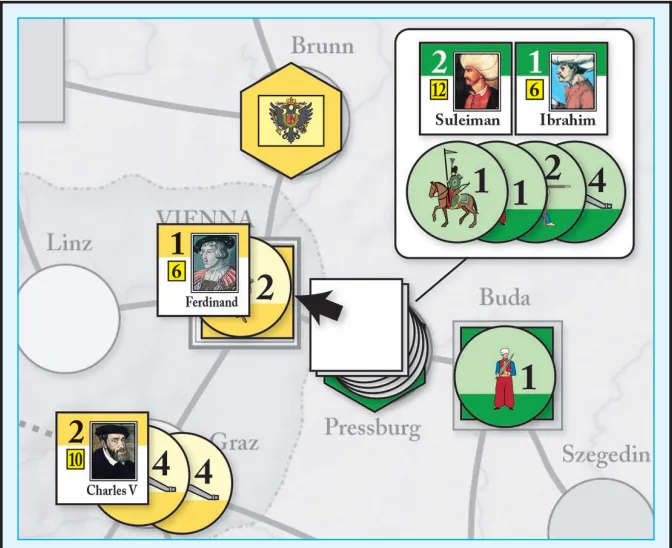
INTERCEPTION AND BATTLE EXAMPLE: It is the Ottoman impulse. Suleiman, Ibrahim, 7 regulars and 1 cavalry are stacked in Pressburg, the space between Vienna and Buda. The Ottoman spends 1 CP to move the entire formation to Vienna. Charles V and 8 Hapsburg regulars are stacked in Graz, adjacent to Vienna. They attempt to intercept, adding 2 to their dice roll due to Charles’ Battle Rating and subtracting 1 for the presence of Ottoman cavalry. Charles’ formation rolls an 8, just enough to complete the interception. [If they had failed the interception attempt, Ferdinand and the 2 regulars in Vienna would have had the option to either fight a land battle outside Vienna (not a smart option!), avoid battle to Brunn, Linz or Graz, or withdraw into the fortifications of Vienna.] In the resulting field battle, the Ottomans roll 8 dice for their units plus 2 dice for Suleiman (their best leader), for a total of 10 dice. The Hapsburgs will roll 10 dice for their units plus 2 dice for Charles plus 1 die as defender, for a total of 13 dice. The Ottomans score 3 hits on their 10 dice; the Hapsburgs score 5 on their 13 dice. 3 Hapsburg regulars are eliminated; the Ottoman chooses to eliminate the cavalry unit and 4 regulars. Suleiman, Ibrahim, and the remaining 3 regulars retreat to the space from which they entered the field battle (Pressburg). Charles, Ferdinand and 7 Hapsburg regulars remain in Vienna.
- 5. Defender Declares Combat Cards: The defender declares any Combat cards he wants to play as events to affect the battle. If more than one major power is controlling defending units in this space, each of these powers may play Combat cards.
- 6. Roll Dice: Both sides roll their dice (taking into account that play of the Combat cards Mercenaries Bribed or Surprise Attack in Step 4 or 5 may force a player to roll a different number of dice than the number arrived at in Step 2 or 3). Each roll of a “5” or a “6” is considered to be a hit.
- 7. Play Janissaries: If the Ottomans were one of the powers involved in this battle and they have not yet played Janissaries this turn, they may play this Home card to roll extra dice in an attempt to score additional hits.
- 8. Declare Winner: The side scoring the most hits is declared the winner of the battle. In the case of a tie, the defender is declared the winner.
- 9. Take Casualties: Each side eliminates 1 land unit for each hit scored by the opposing side. If both sides are eliminated, the side that rolled more dice retains 1 unit. If both sides are eliminated and the two sides rolled the same number of dice, the defender retains 1 unit.
- 10. Capture Leaders: If one or more leaders are present on a side that is completely eliminated, they are captured by the enemy. Place a captured leader on the power card of the adversary which defeated him. He may be regained in the Diplomacy Phase of an upcoming turn (see Section 9).
- 11. Conduct Retreats: The units of the losing power retreat as described in 14.1 (unless they were all eliminated).
- 12. Check for Siege: If the battle occurred in a fortified space and the active player won, check to see if the active formation has more units than the losing player has inside the fortifications. If so, this space is now under siege (Section 15). If not, the active player must retreat his force as specified in Section 15.3, Breaking a Siege.
14.1Retreat
All remaining units and army leaders from the losing power must retreat. If the battle occurred in a fortified space, and the power controlling that space lost the battle, then any number of land units up to four (at the owner’s discretion), and any number of army leaders, may withdraw into the fortifications. The stack of units remaining outside the fortifications after such a withdrawal (or all losing power units if the battle did not occur in a fortified space) must then retreat to a single adjacent space chosen by the owner of those units. That space must meet all the restrictions listed below. If no legal space exists, all units in that stack are eliminated; any army leaders present are captured.
Restrictions:
- Units may not retreat into a space in unrest or a space containing enemy units.
- Units may not retreat into a sea zone.
- Units may not retreat into an independent space or a space controlled by another power unless that power is an ally of the retreating power.
- If the defender lost the battle, his units may not retreat into the space from which the enemy entered.
- If the active power lost the battle, the space chosen must be the space from which this formation entered the battle.