Rule 15
Siege
Land units in a fortified space are placed under siege if they withdraw into fortifications during enemy movement (Section 13.4) or after a field battle (Section 14.1) and enemy land units in that space outnumber them. The land units under siege may not move, attack, intercept, or avoid battle until the siege is broken (Section 15.3). (Naval units in a port under siege may move). Note that it is possible for a fortified space to be under siege by two powers at once if those powers are allies, both are at war with the power that controls this fortified space, and each power possesses more units in the space than the power inside the fortifications.
15.1Assault
A besieging power may spend 1 CP on the Assault/Foreign War action in an attempt to gain control of the space, but not in the same impulse in which the space was first put under siege by that power. A space may only be subjected to one assault in a single impulse (though a power may initiate multiple assaults in different spaces in the same impulse). Assaults are conducted by a single formation of units and army leaders in the same space as the fortification, even if additional friendly units are present. Requirements for an Assault action are as follows:
Requirements:
- The active power must have placed the space under siege during a previous impulse. Fortified spaces that are empty also have to be put under siege in one impulse before they can be assaulted in a later impulse. (Exception: The cards Roxelana and Scots Raid allow players to assault a fortified space in the same impulse that the siege is initiated).
- The assaulting power has an LOC to the space.
- The power that controls the fortified space does not have a naval squadron in an adjacent sea zone.
- If the power that controls the fortified space has naval squadron(s) in that space, there is a greater number of squadrons from the assaulting power in adjacent sea zone(s).
Corsairs are ignored for the purpose of these last two requirements (naval blockade); only naval squadrons are considered.
Assault Procedure
- 1. Declare Formation: The active player declares which formation of land units and army leaders will be making the assault. All requirements listed above must be met at this time.
- 2. Play Response Cards: Other powers may play the Response cards Foul Weather and Gout to disrupt this Assault action. The active player has one final chance to play the Response cards Landsknechts or Swiss Mercenaries to change the number of units in the space.
- 3. Add Up Attacker’s Dice: The active player is always considered the attacker in an assault. The attacker adds up the number of dice he will roll as follows:
If against a fortified land space with no defending land units:
- 1 die for each land unit in the assaulting formation (cavalry units are ignored)
- 1 die for each Battle Rating point from the highest-rated leader in the assaulting force
If against a fortified space with 1 or more defending land units (even if all units are cavalry):
- 1 die for every 2 land units in the assaulting formation (cavalry units are ignored), round fractions up
- 1 die for each Battle Rating point from the highest-rated leader in the assaulting force
- 4. Add Up Defender’s Dice: The player controlling the space is always considered the defender in an assault. The defender adds up the number of dice he will roll as follows:
- 1 die for each defending land unit in the space (cavalry units are ignored)
- 1 die for each Battle Rating point from the highest-rated leader in the defending force
- 1 die for being the defender
- 5. Attacker Declares Combat Cards: The attacker declares any Combat cards he wants to play as events to affect the assault.
- 6. Defender Declares Combat Cards: The defender declares any Combat cards he wants to play as events to affect the assault. If more than one major power is controlling defending units in this space, each of these powers may play Combat cards.
- 7. Roll Dice: Both players roll their dice and add up the number of hits they have scored. Each roll of a “5” or a “6” is considered to be a hit.
- 8. Play Response Cards: Any power may play the Response card Siege Artillery to give the attacker an attempt to score additional hits.
- 9. Take Casualties: Each side eliminates one land unit from their stack of units in the space for each hit scored by the opposing side. (Cavalry units may be taken as losses.)
- 10. Successful Assault: If the attacker scored at least 1 hit, no defending land units remain in the space, and at least 1 attacking unit survived the battle, the assault is successful. The attacker gains political control of the space. All besieged army leaders are captured. Place a captured leader on the power card of the adversary who defeated him. He may be regained in the Diplomacy Phase of an upcoming turn (see Section 9). If the defender has naval units or a naval leader in the space, place them on the next turn of the Turn Track. In a future turn, the leader will reenter play and the naval units may be rebuilt (8.2).
- 11. Unsuccessful Assault: If the attacker did not score at least one hit or any besieged land units remain, the assault is unsuccessful. If the number of besieging land units still exceeds the number of defending land units, the space remains under siege. If not, the attacking force must retreat as described in 15.3. If all attacking land units are eliminated, surviving attacking army leaders are displaced (12.5).
If, earlier in the impulse, units and leaders joined a stack of that power’s units already besieging a fortified space, those newly-arrived units and leaders may participate in the assault and can be included in the calculation in Step 3 (provided that the full complement of attacking forces used can fit within a single formation).
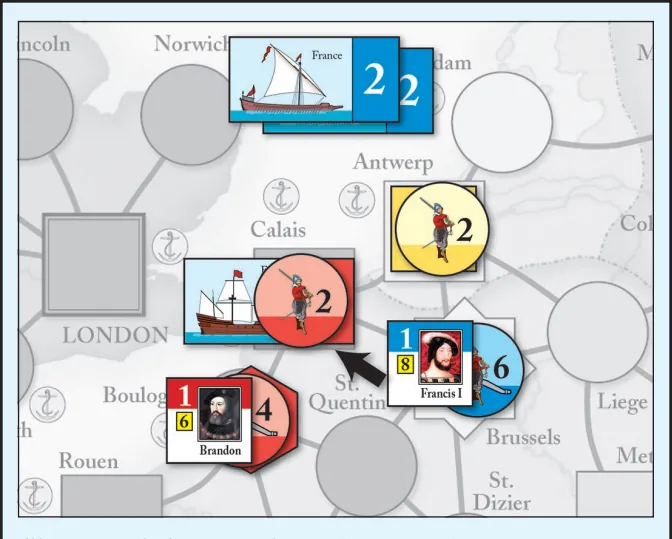
Siege, Relief Force, Assault Example
French Impulse: Francis and 6 regulars occupy Brussels, which is now under French political control. Francis uses a Move Formation in Clear action to move all his units to Calais in an attempt to besiege that key. Brandon’s formation of 4 regulars in adjacent Boulogne fails to intercept this move. The 2 English regulars in Calais withdraw into the fortifications, hoping for relief from Brandon during the upcoming English impulse. Since Francis’ formation outnumbers the English defenders in Calais, that key is now under siege. An assault must wait until the next French impulse.
English Impulse: Brandon now comes to the aid of Calais. The French do not avoid battle. A relief force field battle ensues. The English choose to have the units inside the garrison participate in the battle, giving them 6 dice for units and 1 for the leader Brandon. The French roll 6 dice for units, 1 for the leader Francis, and 1 as defender. The English fail to get any hits on 7 dice; the French score 2 hits. The English take the losses on Brandon’s formation; he retreats with 2 regulars back to Boulogne.
French Impulse: Francis is now ready to assault Calais. The 2 French fleets in the North Sea (compared to the 1 English fleet in Calais ) provide just enough of a naval presence to satisfy the requirements for an assault. The French roll 1 die for every 2 land units (rounding up fractions), giving 3 dice, plus 1 for Francis. The English roll 2 dice for units plus 1 die as defender. If the French can score 2 hits, Calais will fall and the English fleet will be eliminated.
15.2Relief Forces
A formation friendly to the units in the fortification may enter a fortified space under siege and initiate a field battle in an attempt to break the siege. In this “relief force” situation, units and army leaders inside the fortification that are controlled by the same major power as the relief force may participate in the field battle. These forces inside the fortification may participate even if the total number of units now exceeds the allowable formation size (based on the leaders present in that space). The player may choose to withhold units that started the impulse within the fortification from the field battle if he does not want to risk losing them. There are three possible results in this relief force situation:
- If the active player wins the resulting battle, the besieging forces retreat and the siege is broken.
- If the active player loses the battle but the number of hits scored by both sides is equal, the active player may choose to retreat any units or army leaders that participated in the battle into the fortifications(including units that were part of the relief force that entered the space). The total number of units inside the fortification may never exceed 4 after such a retreat. All other attacking units, including any desired units that started the impulse inside the fortification, retreat as per Section 14.1.
- If the active player loses the battle and the number of hits he scored was less than his opponent, units and leaders that started the impulse inside the fortification may retreat back inside. All other attacking units retreat as per Section 14.1. If all attacking units in the relief force were eliminated, any attacking army leaders in the relief force are captured and there is no retreat.
15.3Breaking a Siege
A siege is broken immediately if the besieging stack no longer contains more land units than are in the fortification (cavalry units are included in these counts). This may occur if part of the besieging force leaves the space as part of a Move action, a successful interception, or a successful avoid battle attempt. It may also occur if the besieging stack takes severe losses during an assault or battle against a relief force, or due to an Event card play. When the siege is broken, the stack must retreat to any adjacent space that meets the following restrictions. This retreat does not cost any CP. If no such legal space exists, all units in that stack are eliminated; any army leaders present are captured.
Restrictions:
- Units may not retreat into a space in unrest or a space containing enemy units.
- Units may not retreat into a sea zone.
- Units may not retreat into an independent space or a space controlled by another power unless that power is an ally of the retreating power.